
3.4.2What's up with a cusp?
Curve Constructor: Part Two
Explain why a function must be continuous at


Differentiability
A function,
is continuous at and exists
When a function is differentiable at all values of
The graphs below illustrate functions that are not differentiable at
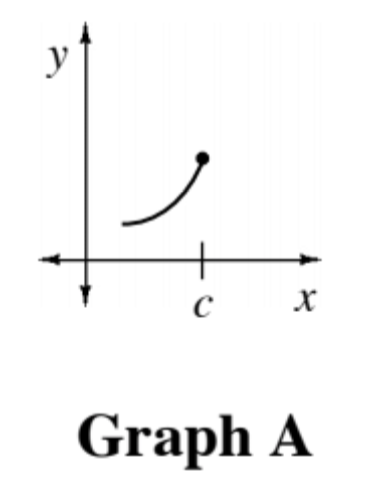
.png)
.png)
.png)
.png)
The “sharp point” in Graph D is often called a cusp.
FUNKY FUNCTIONS, Part One
Graph
and rewrite as a piecewise-defined function. Zoom in at
on your graphing calculator and carefully examine the shape of the graph at . Does appear differentiable at ? Why or why not? To confirm whether or not
is differentiable at , we need to examine . Use your piecewise-defined function from part (a) to demonstrate which condition of differentiability fails at . Analyze
and . Do they agree? Explain.
Use the definition of the derivative as a limit to write the slope function for
THE ABSOLUTE VALUE FUNCTION
Graph
on graph paper and without a calculator, sketch . What happens to
at the vertex of ? Verify your observations by examining the slopes on both sides of the vertex. Use your graphing calculator to determine the slope of
at the vertex. What happened? Part of the reason most graphing calculators incorrectly determine slopes at the vertex of an absolute value graph, as well as other cusps, is because they use the symmetric difference quotient (Hanah’s Method) to calculate the slope of a tangent.
For, use to calculate for and . What do you notice? For functions like of , some calculators falsely calculate the derivative at the cusp as 0. Why do you think this happens?

CURVE CONSTRUCTOR, Part Two
Revisit our computer graphics program from problem 3-82. By using your arc tool, you can make four different types of arcs, shown at right.
The software user can use the arc tool twice and then connect the curves to make a continuous curve, such as the one shown at right. Draw every possible combination of two of these arcs together.

.png)
Which of the combinations you made in part (a) must create a curve with a cusp?
Which of the combinations you made in part (a) have a point of inflection?
Place the combinations appropriately in the Venn diagram at right.


Write the equations of the lines tangent to the curve
For each graph below: Homework Help ✎
Trace the graph onto your paper and write a slope statement for
. Sketch the graph of
using a different color.

.png)
.png)
Write and evaluate a Riemann sum to estimate the area under the curve for
Sketch the graph of a function
for for and for ,
What is
What is the general antiderivative,
Define
Evaluate each limit. If the limit does not exist due to a vertical asymptote, then add an approach statement stating if
Use the definition of a derivative as a limit to write an equation for


